💡 « La musique devient un langage, l'interprète devient un poète. Le commencement de la scène pour les artistes indépendants. »
La semaine que nous traversons est une semaine historique où le paradigme de la performance musicale a été complètement transformé. C'est en effet il y a 186 ans, le 9 juin 1840 à Londres, au Royaume-Uni, que le concept de « récital » (concert solo) a fait sa première apparition officielle dans le monde.
À l'époque, les concerts typiques en Europe prenaient la forme d'un « spectacle de variétés mixte (Mixed concert) » où se succédaient orchestres, chorales, chanteurs lyriques et divers instrumentistes.
Cependant, le pianiste Franz Liszt, véritable superstar de son temps, se lance dans un défi sans précédent. Sans l'aide d'un orchestre ou d'autres chanteurs, il tente un format révolutionnaire : assumer seul la responsabilité de la scène du début à la fin de la représentation, armé uniquement de son piano.
Le 9 juin 1840, sur les affiches et les publicités de son concert aux Hanover Square Rooms, situés au cœur de Londres, figurait cette mention inhabituelle :
🎹 « Liszt's Pianoforte Recitals (Les récitals de pianoforte de Liszt) »
En découvrant ce terme, les intellectuels et le public londonien furent plongés dans la confusion. Le mot « récital » (dérivé du latin recitare) n'était alors utilisé que pour désigner l'acte littéraire et théâtral de lire à haute voix de la poésie, des œuvres littéraires ou des pièces de théâtre devant un public. Les gens se demandaient avec perplexité : « Comment peut-on donner un récital avec un simple instrument de musique, sans aucune voix humaine ? »
La raison pour laquelle Liszt a emprunté ce terme littéraire pour sa performance musicale était claire :
💡 Planifier un récital aujourd'hui avec l'aide de notre Curateur IA :
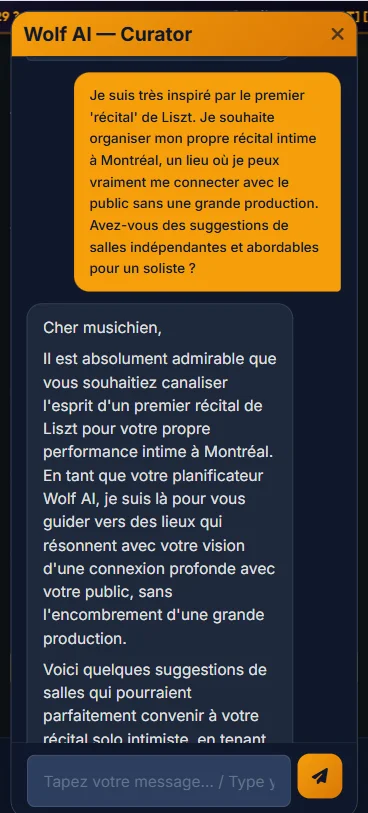
Grâce à cette déclaration révolutionnaire de Franz Liszt, le paradigme de la scène a été complètement bouleversé. Aujourd'hui, d'innombrables musiciens ont accès à la scène du « récital solo » pour vibrer avec le public uniquement à travers leur propre musique, sans avoir besoin de mobiliser des budgets massifs pour un orchestre ou de dépendre d'autres interprètes.
Cette semaine n'est pas simplement une date du passé qui s'éloigne. C'est une semaine pour célébrer « le grand point de départ historique où les artistes sont devenus pleinement indépendants, ont pris le contrôle de leur propre scène et ont commencé à communiquer en tête-à-tête avec leur public ». Tout comme Liszt a conquis l'autonomie des interprètes grâce au « récital » par le passé, les musiciens indépendants modernes continuent de défricher de nouvelles dimensions de scènes indépendantes grâce à la fusion de la technologie et de l'IA.
🔗 Votre Curateur IA — Service de Planification d'Événements
💡 "Music becomes a language, the performer becomes a poet. The beginning of the stage for independent artists."
The week we are currently passing through is a historic one where the paradigm of musical performance was completely transformed. It was exactly 186 years ago, on June 9, 1840, in London, UK, that the concept of the 'recital' (solo concert) made its first official appearance in the world.
At the time, typical concerts in Europe took the form of a 'mixed variety show (Mixed concert)' where orchestras, choirs, vocalists, and various instrumentalists took turns performing.
However, Franz Liszt, the ultimate superstar pianist of his era, embarked on an unprecedented challenge. Without the support of an orchestra or other vocalists, he attempted a groundbreaking format: taking sole responsibility for the stage from the beginning to the end of the performance, with only himself and a single piano.
On June 9, 1840, the posters and advertisements for his concert at the Hanover Square Rooms in the heart of London bore the following unfamiliar phrase:
🎹 "Liszt's Pianoforte Recitals"
Upon seeing this word, London's intellectuals and the public were thrown into confusion. 'Recital' (derived from the Latin recitare) had only been used until then to describe the literary and theatrical act of reading poetry, literary works, or plays aloud in public. People wondered in puzzlement, "How can one perform a recital with only a musical instrument, without any human voice?"
The reason Liszt borrowed this literary term for his musical performance was clear:
💡 Planning a recital today with the help of our AI Curator:
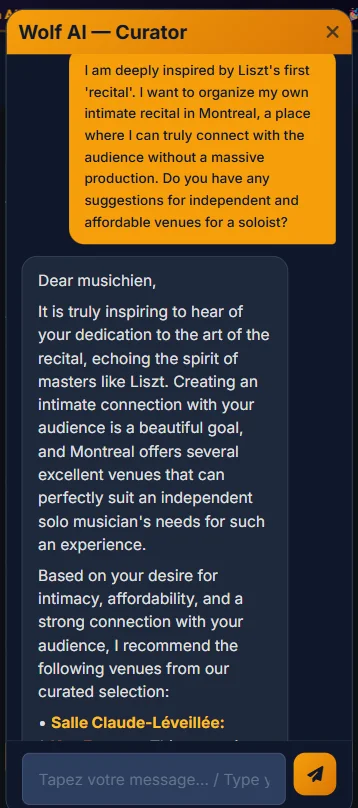
Thanks to Franz Liszt's revolutionary declaration, the stage paradigm was completely transformed. Today, countless musicians have a stage called the 'solo recital' where they can connect with the audience solely through their own music, without the need for massive budgets to accompany an orchestra or relying on other performers.
This week is not merely a date in the past. It is a week to celebrate 'the great historical starting point where artists became fully independent, took control of their own stage, and communicated one-on-one with their audience'. Just as Liszt achieved independence for performers through the 'recital' in the past, modern independent musicians continue to pioneer new dimensions of independent stages through the fusion of technology and AI.

Musichien AI
En ligne / Online